Designing an AI-powered clinic SaaS app, shipped in two weeks
Overhauled Doctiq's core platform into a hands-free, AI-driven clinic and hospital workspace, ahead of a regional medical expo.
Snapshot
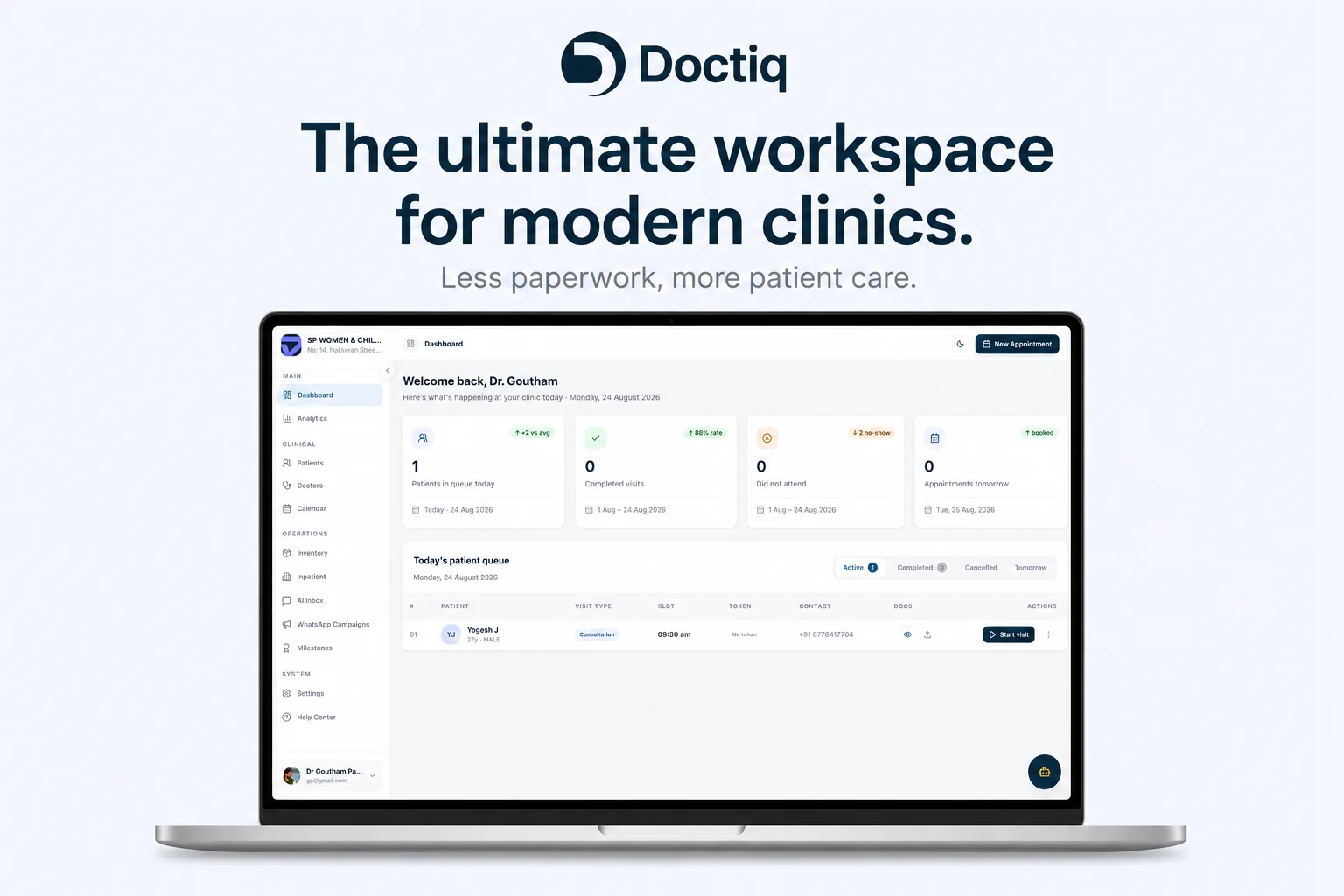
Doctiq is an AI-powered software tool for clinics and hospitals. As founding product designer, I was tasked with overhauling the core platform and shipping a cohesive, demo-ready product in two weeks, ahead of a major regional medical expo. Working solo with an AI-augmented workflow, I designed a hands-free clinical workspace built around ambient voice scribing, automated WhatsApp patient triage and deep modularity.
Visit doctiq.inThe problem
Traditional electronic medical record (EMR) platforms in India force clinicians to spend more time typing into rigid forms than engaging with patients. Four problems compounded:
Doctors spend up to 40% of a consultation manually typing symptoms, vitals and medication instructions.
Inefficient handling of WhatsApp inquiries meant high drop-off, empty slots and revenue leakage.
Incumbents (Practo, DocOn, Eka Care, KiviHealth) impose fixed data schemas that can't flex to multi-specialty workflows, wards or custom prescriptions.
Senior doctors and hospital directors routinely abandon clinical software with steep learning curves.
the brief was as much constraint as problem: solve all of this, cohesively, in two weeks.
What success meant
- Move clinics from fragmented admin software to an automated, hands-free workspace
- Differentiate from rigid incumbents through automation and deep customization
- Give clinicians back their time by removing manual documentation
- Reduce front-desk bottlenecks and missed patient inquiries
- Make the platform usable by non-technical staff with almost no learning curve
Understanding the users
Despite the compressed timeline, I grounded the work in real discovery:
"Dr. Traditional". Needs zero-friction documentation that removes typing without cluttering the consultation room.
Needs live visibility into patient queues, inventory dispensing and automated message triage.
Needs real-time bed occupancy, multi-department admissions and unified billing.
For non-technical clinicians, the winning move wasn't more features. It was getting the interface out of the way: the less the software asked doctors to do, the more they'd trust and adopt it.
An AI-augmented workflow
Shipping an enterprise-grade healthcare SaaS as a solo designer in two weeks meant rethinking the process, not just the product. I built an AI-augmented pipeline that kept strategy and design decisions mine while accelerating execution.
the pace of a team, without handing off a single strategic decision.
Design principles
The solution
I designed Doctiq as a clinical workspace. The headline features:
Trade-offs & decisions
the interesting calls were about restraint.
Stored the raw transcription in a collapsible drawer and gave the main interface to auto-populated prescription fields.
→ the doctor sees decisions, not noise.Built a modular Template Configuration Engine for letterheads, custom fields and reports, without breaking backend validation.
→ multi-specialty flexibility without schema chaos.Prioritized an agile token architecture over a full component library, refining components in code alongside the developer.
→ shipped on deadline, with tokens that still scale.The impact
Outcome figures are client-reported, from interviews and written feedback with our pilot clinics, not formal analytics.
Looking back
“Designing for healthcare is an exercise in subtraction. The wins came from stripping away jargon and keystrokes, not adding features.”
AI, used deliberately, changes what a solo designer can ship: I planned, tested and delivered an enterprise-grade product in two weeks without handing over a single strategic decision. Renaming a technical NLP feature to "Voice-to-Prescription" did as much for adoption as any screen. Next, I'd formalize the token foundation into a full design system now that the product has proven itself.
The setup