Reviving a dead app: from 5 to 2,000+ paid subscriptions in 6 months
Repositioning a failing standalone EdTech app into a core product feature, driving 2,000+ paid subscriptions through UX strategy and ecosystem integration.
Snapshot
Speak+ was a standalone English-speaking-practice app that had stalled at 5 paid subscriptions: decent downloads, almost no conversion. Rather than pour budget into acquiring new users, I repositioned Speak+ as a feature inside Wall Street English's trusted Core Course ecosystem, redesigning its positioning, onboarding and in-app promotion. In six months, paid subscriptions grew from 5 to 2,000+.
The problem
Wall Street English is a global English-learning company built on structured courses and speaking practice with real teachers. Speak+ began as a separate B2C app: unlimited small-group speaking classes on a monthly subscription. On paper it worked. In practice it was dying.
As a standalone product, Speak+ sat outside any structured learning journey, so new users couldn't see why it mattered.
Little to build trust meant free trials rarely converted.
Paid subscriptions simply stopped moving.
a strong feature, trapped in the wrong container: a standalone app.
What success meant
- Grow paid Speak+ subscriptions by integrating it into the ecosystem, not acquiring users externally
- Extend recurring revenue by keeping students engaged beyond course completion
- Reduce dependency on costly external B2C acquisition
- Give advanced learners a clear way to keep improving after structured courses
- Make Speak+'s value obvious within the learning journey
- Offer flexible, unlimited practice tied to real-life communication
Understanding the users
The people most likely to convert were already inside the ecosystem: existing Core Course students, a warm and trusting audience who simply weren't upgrading.
Already paying for a structured course; doesn't want to pay twice for practice.
Finishing levels and looking for a way to keep speaking regularly.
Completed the course; at risk of drifting away without a reason to return.
The barrier was never awareness or trust. Speak+ was built and priced as a separate product stacked on a course students had already paid for. It wasn't an acquisition gap. It was positioning, placement and pricing.
Asking the right question
Before designing anything I ran qualitative and quantitative research (satisfaction surveys and in-app behaviour analysis) around four questions:
Design principles
The solution
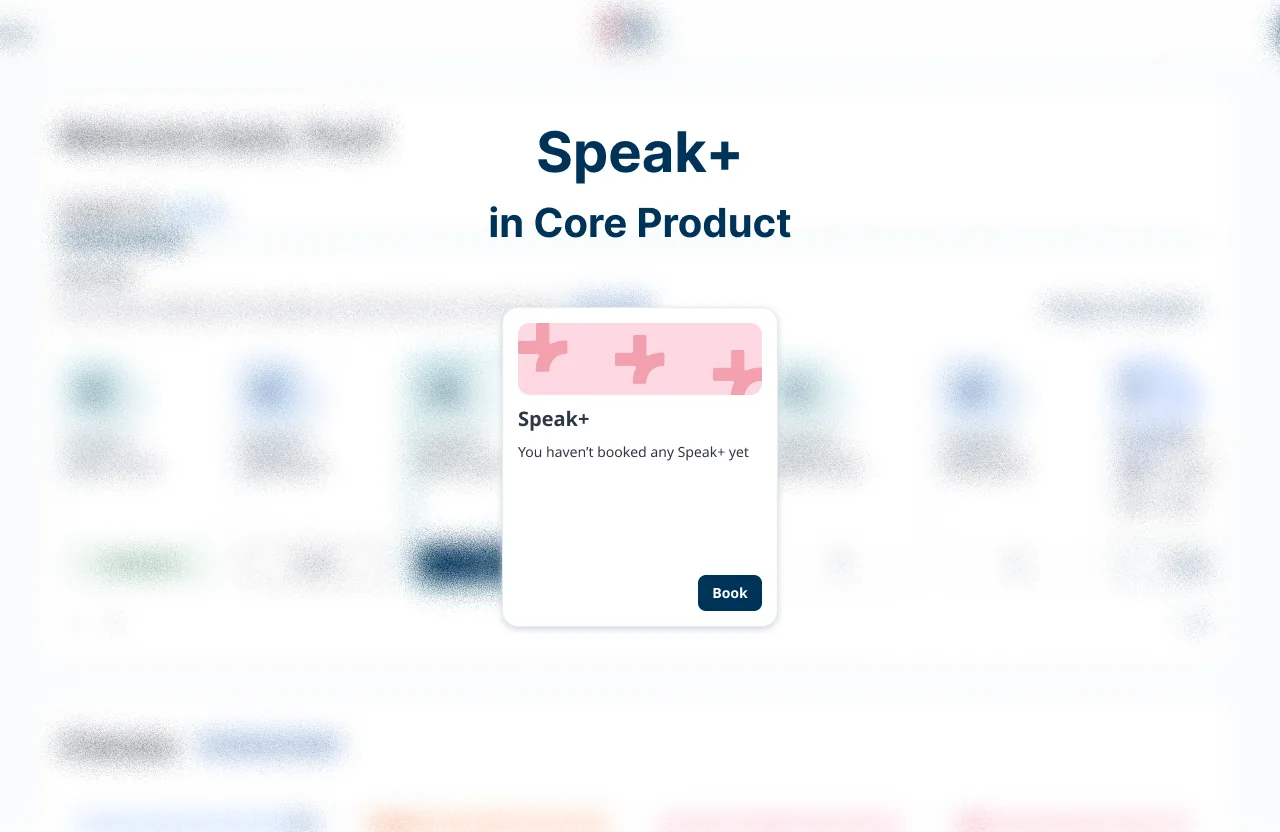
We repositioned Speak+ from a standalone app into a speaking-practice feature embedded directly inside the Core Course experience. Three moves carried the work:
Trade-offs & decisions
the interesting decisions were about restraint, not features.
Keeping Speak+ separate would preserve its identity; folding it into Core would cost that visibility. I chose integration.
→ faster adoption and revenue, at the cost of a standalone brand.I prioritized integration and in-app promotion over new features.
→ significant growth, while feature work waited.An aggressive upsell would convert faster short-term. I chose subtle, context-based education.
→ sustainable adoption without damaging trust.The impact
Looking back
“A stalling product rarely needs more. It needs to be in the right place, at the right price.”
Speak+ didn't fail because the practice was weak; it failed because it was framed as a separate purchase instead of a continuation of a journey students already trusted. The fix was distribution and positioning, not features. Next time I'd instrument the promotion surfaces from the start, to see which moment (onboarding, a level-up, course completion) actually drove upgrades.
The setup